Demonic Sweaters performing live at Hidden Hemp in Brooklyn, NY. Electronic drums, no amps, fully digital performance! Follow Demonic Sweaters on Spotify https://open.spotify.com/artist/6FNgcaIJ1PGGcDmQFU53tb?si=1FYtkoqySjqA0rO1RB18ew. Special thanks to Connie and Giovanni Garcia for the footage to help complete this video! Also thanks to David and Hidden Hemp for letting us put on the event!

Demonic Sweaters is a DIY drumming and music production blog. Explore gear reviews, original compositions, retro aesthetics, and hands-on advice for home recording. Whether you’re a seasoned drummer or just getting started, you'll find fresh insights, creative tools, and real-world tips to fuel your sonic journey—no hype, just authentic passion and practical knowledge.
Showing posts with label Convert Acoustic Drums to electronic. Show all posts
Showing posts with label Convert Acoustic Drums to electronic. Show all posts
Tuesday, November 14, 2023
Thursday, September 8, 2022
Guide to Converting Acoustic Drums to Electronic Drums
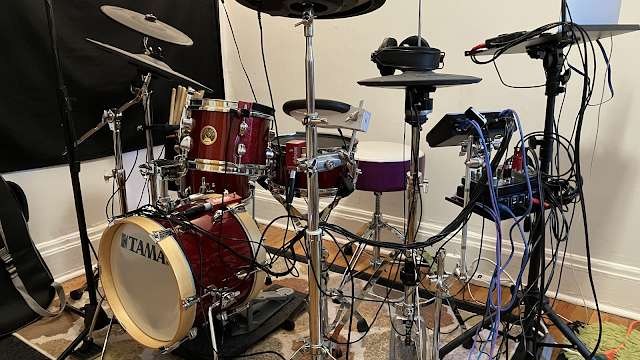
Electronic drums are becoming more popular than acoustic ones in recent years. Don't believe me? Just go to your local guitar center and ask the people in the drum department which one they're selling more of. I think this mostly has to do with one main thing.... volume.
I started on acoustic drums, and they will always be my first love. However, I've gained a real love for electronic drums as well in recent years. After I had my first electronic kit for a year or so, (an Alesis Nitro) I started thinking how I would like to convert an acoustic kit into an electric one and started experimenting with ways to do this myself. I made a lot of mistakes, but through trial and error have come up with a lot of tips to help you do your A2E conversion successfully.
Essentially converting acoustic drums to electronic drums consists of 5 things
- the drums
- the triggers
- hi hat controller
- the module
- the cymbals
There can be more to it than this as you will see in this post, but you can get away with this bare minimum. If you are looking for the most silent option, you can also get mesh heads to replace the mylar heads. Though you can actually convert drums using mylar heads, and make them much quieter than normal drums with household items.
1. Picking your drums: Though technically you can use just about any drum set. I have some tips on ones that will give you an easier time than others.
Smaller drums work better. When converting your drums to electronic, you're going to be using something called 'triggers'. More on this later, but these are the sensors that pick up you hitting the drums and sends those triggers to the module. They sense vibrations, but drums that vibrate too much can be a problem and cause double triggering, or just a general bad response. Larger drums vibrate more than small ones, so it's harder to get a good response out of them (not impossible, but definitely harder). The kit you see above is my tiny conversion kit made from a Tama Club-Jam Flyer, which is one of the smallest adult drum sets being produced today.
I actually made a video about what I think are the best kits to make into e-drums, you can watch that below.
My favorite external triggers are ddrum triggers. Price and performance makes them a great choice. The ddrum Redshot pack is only $99 and comes with 5 triggers for Kick, 3 toms, and snare. They are all single zone though, but for the money you really can't beat them. If you want dual zone snare and better triggers in general, then ddrum's Pro Triggers are the way to go. This pack comes with a dual zone snare trigger, single zone tom triggers, and a nice hefty kick drum trigger. Keep in mind though, ddrum's pro triggers use XLR connections, so if you have a cable snake, you will need adapters like this to make them work. You also will not need the included cables in that pack, so you can buy this cheaper option that does not includ cables. If your module has 1/4" inputs, the included cables that come with the pro triggers in the first pack will work perfectly. Personally, I actually use a combination of Red Shots on my toms, and Pros on my snare and kick with adapters.
3. Hi Hat Controller: This will work in conjunction with your hi hat cymbal to tell the module when you are opening and closing the hi hat. For the sake of simplicity, I recommend using a Roland FD7, or FD8 and just keeping your hi hat cymbal on a normal cymbal stand. There are ways to convert a normal hi hat stand to electronic, but it is more expensive and there are many variables depending on which module you are using, so I will not be covering this here.
4. Picking the module: The module (sometimes called The Brain) is the electronic thing that actually makes all the sounds. You plug all of your triggers into the module, and when you hit the drum, the trigger tells the module you just hit it, and the module makes a sound. If you want to make your life easier, I highly recommend using a Roland drum module! Not because I think they sound better, but they have all kinds of fine-tuning adjustments that really help you dial in the trigger to make it work correctly with your drums. They also are the most compatible with 3rd party drums and triggers. There are other options out there such a Alesis, Yamaha, ATV, Simmons...etc... but if this is your first conversion, Roland will be the easiest and give you the least amount of headaches.
Another option is to use a computer trigger interface, and have your module basically be your computer, but for the sake of simplicity, and to have a stand-alone electronic drum set that does not require a computer I will not be covering this topic in this document.
Depending on your budget, you can usually find a Roland module that you can afford. But if you have a decent chunk of change to spend, why not get the best? The TD-50X is Roland's Flagship module. It is not cheap, but it is the only module you'd really ever need to buy for all applications. But if you're thinking "Are you nuts Justin? I'm not going to spend $3000!!!" Don't worry, there's a lot more options out there.
If you want to spend a lot less, The Roland TD-17 is an absolutely fantastic module for the money. You get sound quality that nearly rivals the TD-50 and a smaller footprint. One step down from that is the Roland TD-07. This is a great module still, just barebones as far as features and has less input and output options. If that's still too much money for ya, head to the used market like Reverb or Facebook Marketplace. There's some real gems of older Roland module that you can find for fairly cheap. The TD-5, this thing is old as dirt, but is still awesome. I regret selling mine. The TD-6, is less old, but still old, but also awesome. TD-9, TD-11, and TD-15s can be found at various prices, but all mostly cheaper than any current Roland Module (except the TD-07).
5. The Cymbals: I can't really think of any better electronic drum cymbal as far as bang for your buck goes, than Lemon Cymbals. If you want to get them at the best price, then you need to go through Alibaba. But these things are really good. Not just good for the money, they're just good. Go ahead and YouTube them, you'll see many people raving about them. The reason they're so good is they work nearly as good as Rolands but are like 1/5th of the price, it's insane. I've been using a Lemon Ride and two crashes for well over a year now, and they're all 3 still as good as they were new. Another option if you want to go dirt cheap and only have single zone cymbals, you can go with Pintech Cymbals. They make dual zone too, but those aren't as reliable, nor do they trigger as accurately as their single zone cymbals from my experience. But if you're using an older module, you might only have single zone inputs anyway. "Zones" refers to the place on the cymbal that can be struck to produce a sound, for example "bell zone", "bow zone", "edge zone". Some cymbals have 1 "bow zone", or 2 "bow and edge zones".
*6. Cables: This will totally depend on your module, because some of them will use cable snakes, some will need individual cables. If it's a module that needs a snake, make sure you get one that includes it. Replacement snakes can be pricy and they're specific to every module that uses them. Some trigger packs include cables like the one posted above in the trigger section.
*7. Mesh Heads: If you really want your drums to be quiet, you're going to need some mesh heads. You can get some Remo silent stokes, or something similar. But as I said before, there's ways around this. You can still use mylar heads, but if you do, I recommend removing your resonant heads, and taking off the batter head off and reseating it over some fabric from an old t-shirt or something to totally deaden the head. This still won't be as quiet as mesh heads, but will function fine and if you don't need to be super quiet, it's a really cheap way to go.
Putting it all together
Once you have everything you need, set it all up, hook up all the cables, get a good pair of headphones, turn on your module and head straight to the trigger settings options. Hit each drum and see how they are working. Some will no doubt be close to working perfectly, while others will be not working great or not at all. Don't worry, we'll fix that.
You will need to understand what every setting does:
Trigger type: You may not have the exact trigger type listed in your drum module's settings, but that's okay. Just try each one until you find the one that performs better than the rest. Then you'll "dial it in" from there.
Sensitivity: Adjust the sensitivity of the pad to regulate the pad response. Higher settings result in higher sensitivity, so that the pad will produce a loud volume even when struck softly. Sensitivity is personal preference. Some people want a realistic response, but others like metal drummers like high sensitivity to even out all of their hits to one volume. Personally, I like a realistic response and keep my sensitivity just high enough so when I strike the drum hard, it sounds full volume, but low enough so my ghost notes still sound like ghost notes.
Threshold: This setting allows a trigger signal to be received only when the pad is struck harder than a specified force. This can be used to prevent a pad from sounding in response to extraneous vibrations from another pad. Set this as low as you can without accidental triggering from other drums.
Scan Time: This is one of those settings that mostly exists in Roland modules and is one of the reasons why I recommend them. Since the rise time of the trigger signal waveform may differ
slightly depending on the characteristics of each pad or
acoustic drum trigger (drum pickup), you may notice that
identical hits (velocity) may produce sound at different
volumes. If this occurs, you can adjust the “SCAN TIME” so
that your velocity of playing can be detected more precisely.
As the value is set higher, the time it takes for the sound to be
played increases.
Mask Time: Another Roland exclusive setting. Mask Time is a way to eliminate double triggering. On a kick pad, for example, if the beater bounces back and
strikes the pad a second time immediately after the intended
stroke—or, like with acoustic drums if you leave the bass
drum beater against the head—it can cause a single strike to
“double trigger” (two sounds instead of the intended one).
The Mask Time setting helps to prevent such problems. Once
a pad has been hit, any additional trigger signals occurring
within the specified “MASKTIME” (0–64 msec) will be
ignored.
When set to a high value, it then becomes easy for sounds to
be omitted when the kick is struck repeatedly in rapid
succession. Set this to as low a value as you can.
Crosstalk (x-talk): This serves a similar purpose to threshold, but functions in a different way. The module tries to intelligently determine what is an intentional strike vs vibrations from another drum. Set this as low as you can without accidental triggering from other drums happening.
Rerigger Cancel: This is another way to handle accidental double triggering, similar to Mask Time, but can be a bit too aggressive if set too high. Set as low as possible. Personally, I like to use Mask/Scan time settings over Crosstalk and Retrigger settings if possible, but sometimes you need to use both.
It takes time to fully dial in your module to your triggers. Just make adjustments, play for a while, then adjust again. Keep doing this until you perfect your settings. If one trigger will not adjust correctly, then you may have some other issues going on. Make sure the drum isn't vibrating too much. You may need to deaden the head more by adding internal muffling, or increasing airflow.
Resonant heads are your enemy: The last thing you want on e-drum shells is resonance. So, you need to deal with those resonant heads. The easiest way is just to remove them completely. If you don't like the way that looks you can either cut giant holes in them, so you're basically left with a mylar ring just to hold the bottom hoop on the drum, or a non-destructive option is to take a couple paper towels, fold them in half, and lay them across the inside of the bottom of the drum on the resonant head. This works great on smaller drums, but once you have a drum 12" or larger, you may have to take a more aggressive approach like cutting or removing the heads.
I made a video very similar to this post a while back, but I have updated some things here, so go by this document first. You can also watch the video though to get some additional information! Thanks for reading, and good luck!
Subscribe to:
Posts (Atom)
Featured Post
Résumé
Justin A.K.A. Demonic Sweaters New York City, NY www.demonicsweaters.com | YouTube | Instagram | TikTok 📧 demonicsweatersmusic@gma...
